If you are looking for a perfume manufacturer for your brand but are not yet sure how to define the collaboration model that best fits your project, your budget or the level of differentiation you are after, we will help you clear up any doubts.
We are going to explain the different options a third-party perfume manufacturer offers (Full Service, Private Label and Contract Manufacturing) and how they translate into an industrial process.
3 details to consider before choosing a partner for perfume manufacturing for brands
Before a perfume reaches the store shelf, there is a process that begins the moment the brand starts looking for a perfume laboratory. The brand’s needs, both creative and production-related, will determine the type of partner required: from an idea with no formula to an already-approved fragrance. That is why different models exist for fragrance manufacturing.
First, reflect on these three questions:
- Do you already have a formula, or do you need fragrance development?
- Do you also need the partner to manage the bottle and packaging?
- Is your priority speed to launch or exclusivity?
Now, let’s answer these questions.
Full Service perfumes: from the idea to the finished product
Full Service perfumes is the most complete model. The manufacturer acts as an industrial and creative partner: it guides the brief, coordinates the perfume-creation laboratory (in-house or with external perfumers), industrializes the packaging, produces and delivers the product ready for the channel.
Services included in the Full Service model:
- Brand brief and concept.
- Olfactory development (3-5 proposals).
- Adjustment rounds with documented feedback.
- Bottle and packaging design, prototypes and validation.
- Production, packaging and final conditioning.
- Quality control, traceability and market-specific documentation.
Which projects does the Full Service model fit? New brands, repositionings, premium launches and international projects where you need control and coherence across the whole journey.
If you are looking for a partner that makes the difference, look for…
- Clear phases that include approval milestones: brief → proposals → adjustments → formula approval → industrialization → production → delivery.
- Documented decisions: modification rounds with structured feedback and deliverables per phase (samples, costs, validations).
- Confidence from the outset: NDA before any technical conversation + batch-level traceability and complete documentation for your market.
Private Label perfumes: speed with brand personalization
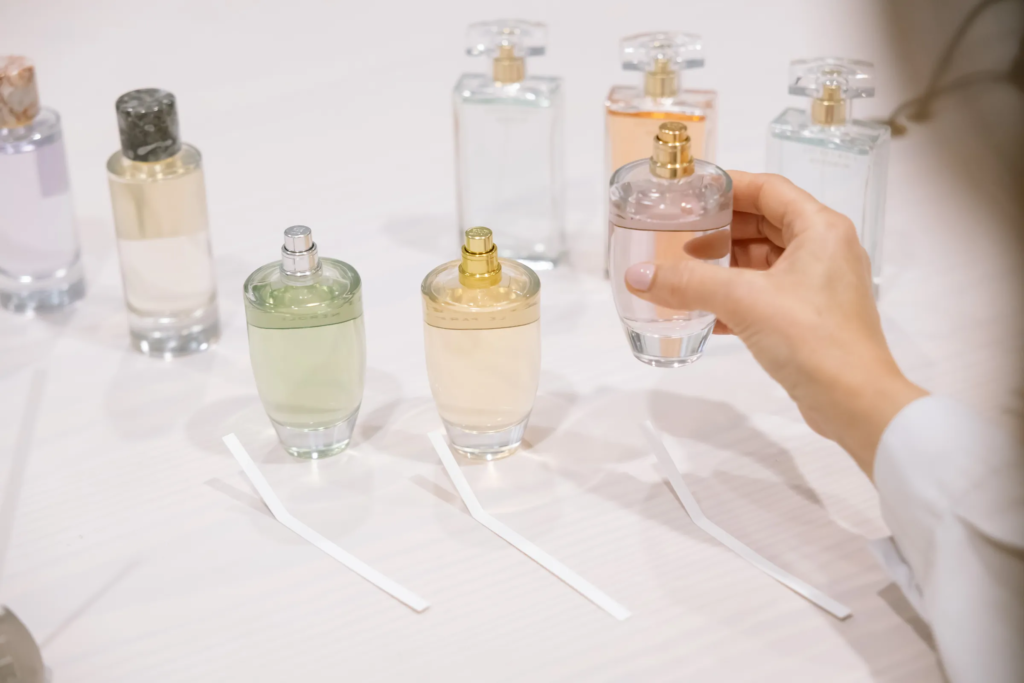
The Private Label perfumes model starts from already-developed (catalogue) formulas. The brand chooses a base and adapts it to its positioning: concentration, nuances, naming, packaging and presentation.
It is the most efficient model to enter the market quickly, when you don’t need (or don’t want) to develop from scratch.
Services included in the Private Label model:
- Selection of a catalogue formula.
- Olfactory adjustments to fit your brand.
- Packaging personalization (from standard to premium).
- Turnkey production, packaging and delivery.
Which projects does the Private Label model fit? Retailers, seasonal collections and gift sets.
Bear in mind that, even when working from a catalogue perfume, the Private Label model demands the same level of control and documentation as a bespoke development.
Contract Manufacturing: you provide the fragrance and the manufacturer handles everything
Contract Manufacturing of perfumes consists of manufacturing fragrances for third parties: the client brings the formula and the manufacturer focuses on production, packaging, quality, traceability and logistics.
Services included in the Contract Manufacturing perfumes model:
- Formula receipt under NDA.
- Industrial planning, scale-up and controls.
- Packaging and final conditioning.
- In-process and final quality control.
- Documentation per batch and per market.
This model is ideal for brands with their own formula, fashion houses with a defined fragrance, or projects where development is already closed and the critical point is executing at scale.
And remember: in the Contract Manufacturing model, the formula is 100% the client’s. The manufacturer safeguards it under NDA and takes care of producing it.
Launching a fragrance project? Let's talk
From the model to the working method
Once you are clear on which type of collaboration model is right for your perfume launch, it is time to check whether the manufacturer’s working system is well defined.
In the case of Air-Val Perfumes, we work under the three collaboration models analysed and with a method divided into eight steps:
- Brief & consultancy.
- Olfactory development.
- Refinement.
- Formula approval.
- Design & packaging.
- Industrialization.
- Manufacturing & packaging.
- Delivery with documentation.
Working to a clear method reduces incidents and speeds up decision-making, so you can move forward with confidence at every step.
What should you consider when you need a perfume manufacturer for brands?
If you are comparing several perfume factories to choose your next partner, these questions will help you clear up any doubts:
- Which model fits my project: Full Service, Private Label or Contract Manufacturing?
- What industrial capacity does the factory have (lines, square metres, units/year) and how does it manage production peaks?
- When is the NDA signed?
- How is traceability guaranteed and batch-to-batch variation controlled?
- What documentation is delivered per batch? (COA, SDS, IFRA, allergens, technical data sheet, etc.).
As you have seen, perfume manufacturing for brands includes different collaboration models that combine creativity, manufacturing processes and regulatory compliance, so choosing the right company to work with is what will make the difference in your next launch.
Let’s talk.